Showing posts with label M G Boshoff Attorney. Show all posts

Monday, 6 April 2020

Our Courts and Lawyers during Lockdown


Hello, everyone!

I am not one to jump on bandwagons, and I am also not going to start, but I have felt that many of my clients have not heard from me since 27 March 2020 and I have also not heard from them either, so-

I think it is time to say something...

First- if the numbers that I got from the Covid-19 Info Centres of Facebook and Twitter are anything to go by we have almost halved the rate by which the Coronavirus has spread here in South Africa within a week.

Good job, everyone!


I hope we stay strong and safe together and that we will reduce the spreading to zero within the coming week. 

Until that happens- I have noticed that some of my clients still remain concerned about the progress in their matters.

That- in itself- is a good sign. It means we are still expecting life to return to normal much sooner than the economy will collapse...


Other lawyers will tell you that we are also confined to our homes now. Most of our court cases that were to be heard on dates that now fall within the Lockdown period have been either postponed to expected dates after the Lockdown or put on indefinite hold for us to enrol again once we return.

Those are your normal civil matters.

Soon after the Lockdown had begun, however, we have been informed that our courts now operate on skeleton staff being available to help with only urgent, essential matters. The interpretation of what exactly is deemed "urgent and essential" was not left up to us.

In our High Courts people that wish to challenge the constitutionality (in laymen's terms that would translate to fairness and validity) of the measures currently imposed by the State to combat the spreading of the Virus shall still be heard and the Court remains available for that.

Then- any other matter that is urgent and that can result in serious hardship for an applicant if it is not heard immediately-can still be brought before the High Court. High Courts have inherent jurisdiction, which means that you cannot really limit this category of cases to only a certain kind, but- don't be surprised if you have reckoned that the circumstances of your case merit urgent hearing and find that the Court does not share your view. The test I always apply is: "What will happen if we wait until after the Lockdown?"

As for Lower Courts I do not see any work for the Civil District Courts or Civil Regional Courts, but our Family Courts remain open and available to deal with the matters listed as follow in the Regulations:


That does not mean, however, that attorneys and advocates are now allowed to travel back and forth between home, office and court to attend to these matters.

The form that you see on top of this post is actually to be used by a lawyer to apply for a permit to leave his/ her home to attend to any of the matters mentioned above.

How long it takes for such a permit to be issued I do not yet know, because I have not yet had to apply for one. If I do find out I will let you know.

As for consultations- technology is of a much greater help these days. I can imagine the astronomic phone bill of anyone that opted for telephonic consultations if this Lockdown was imposed on us during the 1980's.

Now- with all the internet based voice and video chat applications- and even email- at our disposal, we can still maintain contact with our clients, give advice and get the information that we need. 

Before I stop typing I just want to thank my clients for their continued support. I realise that we are in for a tough time ahead and seeing that you are still here means a great deal to me.

Stay safe and, for the time being, let's stay out of court as far as we can...


Saturday, 11 January 2020

Best wishes for 2020- Another great year to serve

Image may contain: 1 person, suit, closeup and indoor


A warm hello to all clients and readers of this blog.

I hope that you have all managed to at least find some way to end the previous year and not just the previous month.

I have stayed open during this last December for the longest time I remember in this practice's history.

Now- I am at Year 4 if we count only count the full years of myself practicing for own account.

I was glad to have managed to prevent a dear old lady from being evicted from her own home in which she had been living for more than 30 years.

Last year was also the first year in which I have obtained a court order that allows a divorced mother to leave the country with her children without having to obtain the father's consent. To top it all- the order allows her to emigrate. I know of a couple of mothers who would just like to take their children across the border for a vacation...

This year, however, promises to be exciting.

Among the numerous developments in our Law the Uniform Rules of Court has gotten a new rule in terms of which a judgment can now be rescinded in the judgment creditor consents or if the judgment debt and costs are paid up.

What does this mean for you?

Well- just a year ago you were not able to get the judgment for your arrear bond payments removed from your name even when you have paid the full outstanding amount. That reason for rescinding or setting aside a judgment did not exist back then. Now, however, a judgment debt being paid- up and consent by the judgment creditor are grounds on which you can apply to get such judgments set aside.

I look forward to handling a couple of such matters.

In other news I am happy to say that I have learnt that motor vehicle financiers are not as merciless as I have initially thought them to be. I can now invite those of you who are trying to get hold of the bank when you need to make arrangements to accommodate you in your financial distress. Believe me- the result of communicating with the bank before summons is issued is a lot better than that of trying to negotiate after the court has already authorised the removal of your vehicle.

Then- although this is not the last in the list of services that I have to offer for this year- I want to remind businesses that I gladly help them recover debts owed by those entities who seem good at either hiding themselves or their assets. 

With regard to debt collections I have decided to take only 10 percent collector's commission on recovered debt payments rather than giving the client an itemised bill every month if that client gives me 10 or more debtors to handle. Although there may be some cases where I shall choose not to pursue some debtors altogether, mostly to avoid having to incur severe costs, this way of working actually saves the client more money and has a bigger likelihood of letting the client experience money coming in rather than paying more than the amount he is trying to recover.

And- with that- I wish you all a pleasant return to work and a wonderful year ahead.


Sunday, 13 October 2019

You the Unpaid Subcontractor

Image result for construction site


The story is heard more and more in South Africa, especially in the construction industry-

Your BEE score is definitely not even nearly right for you to be awarded the tender, but the contractor that did actually get it has given you your big break. You are now a subcontractor and in line for your slice of the pie...

Then comes the payday... or... it does not come...

You find out that your benefactor has already been paid by the government department that is his client, but he has conveniently forgotten to pay you.

So- what do you do?

Well... For many subcontractors the contract is still too big an opportunity to pass up and they stay on board- usually having received some promise of payment at a later stage or an arrangement with the client to pay them directly the next time.

Some wait for months on end for payment and pay their workers out of their pockets.

Others suffer huge losses and go out of business...

It is common knowledge by now that a large number of bidders who do get awarded tenders for government construction projects have absolutely no knowledge or experience of the work that they undertake to do. In cases like these the contractors rely on the expertise of their subcontractors to earn them the money that they pocket.

Some of these tenderpreneurs, however, care only about what the money paid by the Government can do for them and they have a habit of first spending this money on what they want before paying any of their business debts. This usually gets demonstrated very clearly and it is important from a legal point of view to take note hereof.

So- once you have found that your client, the Tenderpreneur or Government Contractor, has left you in the lurch- what can you do without involving the courts?

Well... the truth is- not much...

You may think that the signed undertaking to have the next payment go directly into your bank account instead of the main contractor's has solved the problem, but what you don't know is that the government department involved is not automatically bound by this arrangement between you and the Contractor- not even if that trusted contact at the government office is present when the arrangement has been made.

A government department's procurement and supply chain management policy is very strict about where public funds are to go during the course of a project and if your arrangement for direct payment is not approved by the government department in question you have a contractor that will defend himself with that the problem now lies between you and the Government and that trusted contact that stops answering your phone calls when the money does not come when it is expected.

So- you will most likely not get very far without an attorney when your mandator stops paying you.

So- what can your attorney do for you?

Here are the options that you can consider:


1. Business Rescue: 

No. Not for you! For the Mandator! Before this term had entered our law we used to have judicial management. Well- we still do, but it is called Business Rescue now. Not only the owner of a company, but also a creditor of such a company can approach the Court with an application for the company to be placed under Business Rescue when the creditor can demonstrate that the company has a steady enough cash flow, but that the money just does not go where it is supposed to, or, that the company does not have much of a cash flow, but that it SHALL improve if a competent person is placed in charge.


2. Anti-Dissipatory Order: 

You cannot get a garnishee order against an organ of state from your local Magistrates' Court. The High Court, however, can make sure that that retention money that is still lying with the government goes nowhere until the legal proceedings that you have instituted are finalised.


3. Winding- Up:

We may all know that winding-up is the automatic choice for a creditor when the debtor appears unable to pay his debts, but winding-up proceedings have another use as well.

Every now and then you find a crafty tenderpreneur who is the director of not just one company, but also a director of a couple of other companies, member of a close corporation or two or even a trustee or beneficiary of a family trust.

The moment you start looking for the money that was supposed to have come to you, you find that large amounts thereof have gone to all these different entities. A liquidator, however, is able to track down these lost funds and recover as much thereof as possible for the benefit of creditors.


4. Priovisional sentence:

Many learned colleagues can name a number of circumstances under which this remedy is appropriate. What these proceedings do is bypass the necessity of a full action procedure (which includes a trial) and jumps straight to the hearing of the matter. Instead of oral evidence, parties usually present their sides of the story in their affidavits and parties usually need not present oral evidence. Most of the time spent in court (besides waiting for the matter to get called, of course...) is spent on arguments presented by legal representatives of the parties. It is a much quicker way to get judgment in your favour than your normal action procedure that starts with a summons and that only reaches the trial stage after a lengthy process of exchanging all manners of paper.

Now- I have said that learned colleagues can name a number of circumstances under which you can apply for this relief, but I say your best bet is when you have the following:

1. A written acknowledgement by the debtor (who is of course the Mandadtor)

2. of the precise amount owed; 

3. that contains no conditions yet to be met by you (or which confirms that you have met all conditions for payment);

4. which can be a letter, email or a written undertaking to pay.


5. Action procedure:

This is really your last resort. This is your option when you have no such document that qualifies you for provisional sentence and your claim for payment is disputed.

Sure- it costs money and it takes time, but having proceedings like this on the court roll places you in a far better position than trying to phone people who have long since stopped answering your calls...


So- If you are a subcontractor that is experiencing non-payment by your mandator- don't just leave it to chance. Contact me and let us get something done about it!


Saturday, 6 April 2019

Why I do not always like to keep things out of court

Those who know me will be able to tell you- I enjoy going to court. I am in the best of moods on my court days.

I might have a case that worries me a bit, but worry soon gets replaced with focus when the proceedings start.

Still- I have to admit that it is much better for the client if a matter can get settled out of court- or is it?

Well... It can be, if you know what you are looking for and you also know the consequences of the choice that you are to make between proceeding in court and settling out of court.

The main benefit of settling a matter out of court is that it puts an end to the running up of litigation costs for both parties. Sure- you may still get charged for a letter getting written here or there, but that is not nearly the cost of a full day in court. If settling can save you the cost of at least one day in court it is definitely worth it.

So- settling is the way to go, right?

Unfortunately for every tool the law may give us to help us there is someone who finds a way to abuse it. The same is true for settlement negotiations.

It is not uncommon to find your opponent's attorney trying to buy an indefinite amount of time with a phone call to your attorney in which he makes some vague, non-commital promise of an offer for settlement. I am actually asking myself whether there can be such a thing as a non-committal promise.

:D It appears to exist in our line of work...

So- when would it be a good idea to get your matter ready for trial?

The following circumstances are usually a good indication that it shall be better to go to court:

1.  If it is the only way to finalise the matter. In many cases a defendant does not want to see a matter finalised, because finalising the matter will mean that he has to pay! If you are a plaintiff and the defendant does nothing but avoid you- you are going to need the court's help.

2. When it will actually cost less to have the matter heard in court. Some plaintiffs get really creative when they start claiming money from somebody- especially if that somebody seems to be a push-over that will pay anything that the plaintiff demands. In this life we find the motor owner that want you not only for the dent on his bumper, but also his wheel alignment and te removal of scratches on surfaces of his car that did not even have contact with yours! That person is definitely not going to be happy with your offer and he would rather bully and badger you as much as he can outside of court. In a case like this it is better to have the person sue you so that the matter can be properly adjudicated in court. As long as you remain acting in good faith the court will see no need to penalise you in any manner.

3.  If your opponent's proposal is to give you far less than what you will be awarded by the court. In some cases accepting "nuisance money" instead of incurring the cost of a day in court is the better idea. What is not as good is when an unscrupulous opponent counts on your willingness to keep a matter out of court and then tries his best to bully you into accepting an offer of far less than what you are actually entitled to. 

The above 3 circumstances are actually reasons why I have saved clients a lot more money by going to court instead of staying out of it. I am sure you will see the difference between paying for a 2 hour meeting with your opponent and his attorney that has led to nothing and paying for the same amount of time in court that got you a court order in your favour...


Friday, 8 February 2019

Emergency Monetary Relief in terms of the Domestic Violence Act- Quicker than Maintenance Court, but Definitely NOT a substitute for maintenance proceedings!


Hello, everyone!

I admit that I do not write here very often. When I do write something on this blog it is usually I am having a very quiet time at work and then use this platform as a means to get the public's attention.

Today's post, however, is something for which I have specially made time during a really busy month because it deals with something that is often much needed by divorce clients, but not so often obtained by attorneys. I will explain the reason for this very shortly.

If you have read some of my earlier posts you will know by now that I do not take a "chapter-and -verse" approach that involves the quoting of legislation and case law.

My reason for writing the way I do is mainly because these posts are not intended for some legal journal or a doctoral thesis on any aspect of law. It is also not for my colleagues to take note of, but for you- the people.

This is why I keep this kind of post simple and why I try my best to make it the least boring legal article that you are likely to read.

Now- what this post is actually about:

I have recently gotten the Domestic Violence Court to order my client's husband to pay my client money.

It sounds strange, right?

The Domestic Violence Court is there for issuing protection orders (what the people in the U.S. call "restraining orders"), not to make any awards for money to be paid, right?

Well... Not exactly-

You see- domestic violence can take on a number of forms- in our law that number is 10, actually...

If you want to know all 10 of the forms domestic violence can take you can read this short excerpt from Section 1 of our country's Domestic Violence Act (That is Act 116 of 1998 for those who are actually interested in reading the entire Act...):
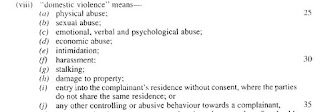


Noticed (d) in the excerpt above? It names "economic abuse" as a form of domestic violence.

We all know what economic abuse is, don't we?

Well- not all of us...

That's okay- It is easy to explain.

In many domestic relationships, be it a marriage, an unmarried couple living together or that of parent/ guardian  and child we find that one party to this relationship is financially dependent on the other.  The breadwinner in this relationship can easily use this financial dependence to hurt or manipulate the dependent party- and in many cases they do just that.

In my client's case her husband wanted to put pressure on her to agree to the least expensive settlement for him before the divorce proceedings started so- before going to see a lawyer he told her that she had a month to get out of the house and that he has cancelled the lease to their home and will also stop paying the rent after this month...

So- what is she to do?

The Maintenance Court will give this man 2 weeks to come to court with his bank statements and then take another month to get this matter heard by a Magistrate.

We have not yet even issued a divorce summons and even if we did a Rule 43 (High Court)/ Rule 58(Regional Court) application (for maintenance to be paid pending divorce proceedings) have the inherent weakness of giving the Respondent 10 work days to file his answering affidavit (which he usually delivers to your attorney late in the afternoon on the 10th day) and then the matter gets heard only in the next month- if you are that lucky!

By that time the rent is already skipped and the Landlord already scrambling to get my client and her children out of the house! If he is a good law-abiding landlord it would mean that my client now has the added burden of eviction proceedings and if he is a bit more of a loose canon my client could find the doors to her home removed and all her possessions strewn across the street in front of the house! (Don't laugh. I actually sympathise with these landlords, because they have most likely become disillusioned with our legal system when they had a family of freeloaders dealing insane amounts of damage to their homes before they eventually took their leave... I digress now, however. Let's get back to the topic at hand...).

So- we couldn't pass this buck to any other court. We know now that the Domestic Violence Act knows about a thing such as "economic abuse", but how does it deal with it?   

The answer to that question lies with Section 7(4) of the Act that reads as shown below:



Well- I would have preferred to have the section say that non-compliance with the order is a criminal offence and a one-way ticket to stoxing (prison) like the case is with contravention of protection orders in respect of other forms of domestic violence, but I can work with this as well...

Now- I have mentioned that many attorneys have tried and failed to get this kind of order. The main reason for this is because they miss the difference between preventing or stopping an act of domestic violence with compelling somebody to maintain a dependent.

What is the difference between the two?

There are actually a number of differences:

For one: Where the duty to maintain a spouse automatically exists during a marriage and the duty of a parent to obtain a child exists as long as the parent is the legal parent and guardian of that child- unmarried adults living together do not automatically have a duty to maintain one another. One of the parties can obtain that right by applying for a maintenance order, but then the court has to first determine whether the need exists and such right can be awarded to an applicant.

In the case of economic abuse the court needs only to know that the parties are in a domestic relationship- be it married, living together, related or in a romantic relationship and that the complainant is financially dependent on the respondent.

 Secondly: A maintenance order covers a wide range of expenses starting with the most basic of the dependent's needs, but in appropriate cases branching out to those expenses that a dependent would have incurred in order to ensure his/ her education and to maintain living standards to which he/ she are accustomed.

Economic abuse does not go that wide. Your dad cancelled your horse riding lessons? Move on! That is not what the Domestic Violence Court is for.

Thirdly: The economic abuse that a complainant refers to this court has to strike at the very basic needs for human survival: food, a home, healthcare, medical treatment.

A man who has never maintained his child before can still get a maintenance order against him to do so. If somebody in a relationship has never before made certain payments to his partner then the Domestic Violence Court cannot introduce a new regime where he now has to make those payments.

It becomes an act of violence when the financial support on which somebody is dependent and accustomed to receiving suddenly gets withdrawn for no good reason- or for very bad reasons indeed...

Fourthly- A maintenance order can serve to improve the status quo between the dependent and the breadwinner. An order for emergency monetary relief can only endeavour as far as possible to preserve the status quo between parties. This is why a maintenance order application involves a detailed enquiry into the financial positions of the parties while in the case of an application for emegency monetary relief the court needs only to satisfy itself with the status quo before the sudden withdrawal of financial aid.

Lastly- I realise that I should probably have put this difference at the very op of this list- the operational word here is "emergency". Emergency monetary relief is meant to avert a sudden crisis. To deal with an emergency.  It implies that there is no time for coming back for a meeting in the Maintenance Officer's offices to get a court date somewhere in the next month.

I have now come at the end of this article, but anyone interested in finding out more about domestic violence proceedings, maintenance order applications or other related topics can contact me. My details are below:


Saturday, 3 February 2018

Execution against Organs of State


Lawyers, I trust, have no trouble knowing whose assets to go after when they have obtained judgment, but I have noticed over time that some departments of our Provincial Government here have begun with a lot of confidence to attempt to mislead us.

One instance- in Mbombela High Court case 898/16 we got an order for costs against the Plaintiff who was an organ of state and department in provincial government who had instituted an action that was actually supposed to have been instituted by another department altogether.

One would think that the Plaintiff had learnt his lesson after having had to withdraw on this technical point and tender costs.

Next thing that happened, however, was that I received emails from yet another government department who wanted to pay the Plaintiff's costs as per the taxed bill, but- wait for it- I first had to register as a VENDOR on their system!

This, of course, is a load of hogwash!

Neither an attorney in my position or the Sheriff should be thrown off by delaying tactics such as this. A functionary in an organ of state who is liable for execution is an execution debtor like any other and his assets are liable for attachment like any other. Those enormous salaries they get can also be attached if the correct procedure is followed.

Personally- I consider being sent from pillar to post by someone who just has to shut up and pay as an insult.

Having to register as a vendor with the indebted organ of state may make things easier for them internally to process the payment, but any delay of longer than 3 days is a delaying tactic.

If the Provincial Government does not yet understand this we shall just have to teach them by experience time and again.  

Monday, 4 September 2017

Dealing with your Debts

So, times have become tough and you can't afford to pay your rent whilst having to care for your family and now you lie awake at night seeing no way out...

This is no situation in which any of us would like to be and definitely not the type of situation in which any of your creditors would like to see you either.

If you are the type of person who chooses to happily run from creditors and avoid paying this article is not for you. In fact- with our laws as they are today- you don't need legal advice. You need to take responsibility.

If you however are the type of person who does not want any judgments against his name and who prefers to pay all your debts, even if you can't afford to do so due to circumstances beyond your control, I am here to tell you how to protect your assets- especially if you did not safely put it away in a Trust or a Company. What I say also applies to those among you who do not have assets of any great monetary value.

Debt counselling is unattractive to many of us, because it gets noted on your credit record. Still- it has the most basic solution to managing your debts. When your income has dropped to a point where you are not able to meet all your obligations a debt counsellor takes your income and makes arrangements with creditors to pay debts off in affordable installments while leaving a large enough portion of your income for you to cover your living expenses.

It sounds fairly simple, right? So- why can't you do it yourself? Surprisingly- the answer is not that you are not allowed by law to do so, but it is because most creditors are not willing to accept offers to pay debts off in installments. That is, however, until they have obtained judgment against you and the court tells them to.

So- the important thing about making an offer in writing or proposing an arrangement is the timing.
Now- I assume we all know that your creditor is not allowed to take any of your possessions by himself or to use any violence or threat thereof in collecting monies due. Your debt does not preclude you from getting the protection of the courts and the police if any of your creditors does act in this manner. If a creditor wants to enforce his debt he has to sue. For this most creditors need a lawyer and it is at the stage when you know that a lawyer has been appointed that you make your offer.

This sounds bad- I know. The truth, however, is that most creditors are unwilling to make any arrangements with you until their lawyers have talked some sense into them and in some cases, only after the court has told them to accept the installments.

The more cynical among creditors may believe that you are merely pleading poverty to mislead them. If that happens the closest they can get to being convinced will unfortunately only come after judgment has been obtained against you, allowing the creditor to have the Magistrates' Court in your district conduct an inquiry into your financial position.

The best you can do to avoid this is to make the best offer that you can manage and to not prioritise luxuries over your commitments.

If an arrangement is in place and accepted by both parties it has to be in writing and kept to. Sure- it binds you, but it also protects you. In many instances it also tells you when you will be done paying.

It is important to note that debts in respect of which you are not sued prescribe (lapse) after 3 years. A in respect of a debt for which you are sued, on the other hand, stays valid for 30 years.

There really is no other way of overcoming debt other than taking responsibility and doing your part. Hopefully the advice in this article will bring at least some of you peace of mind.


Monday, 15 May 2017

Thank you to those who trust me- and welcome to those who have not yet come to me


It has been a long while since my last post to this blog.

I am glad to say that it is due to my having become really busy since I have opened my doors in August last year.

The increase in clients that I am experiencing is one of the greatest blessings any firm can experience.

When one considers that I am a single practitioner that is 100% personally engaged in all the work undertaken by this firm it may be surprising that these clients did not choose to go to the competition in some of the large buildings here in Nelspruit.

Large firms have their advantages and I also realise that clients have a lot of options when they are looking for attorneys. What some clients also realise, however, is that the advantage of having an attorney directly involved in your case without any staff or intermediaries makes finding the person responsible for your file that much easier. 

These clients are also up to date on the progress in their matters and they can actually see developments in their matters when they happen. Even though these clients get regular feedback they can also easily follow up with me.

The same person that takes the instructions from a client also drafts the court papers. No information gets lost between the person that has done the consultation and the person that is going to draft the papers.  

This personal involvement is of the utmost importance and is the cornerstone of my style of practice.

Thank you to my current clients for their support.

If you feel that your legal problems need personal attention- feel free to contact me.


Tuesday, 7 February 2017

The uphill battle


No matter how much I want it to be otherwise- Litigation can often be a long and tedious affair. No- that is an understatement. It can be draining- both emotionally and financially.

To make matters worse you will often find the court as one of your opponents.


More than once I have found myself thinking that there is no place for legal practitioners in this country simply because we find judges, magistrates and the police more willing to find excuses to show us away than to assist us.


I have realised, however, that if that is how I struggle it can be worse for a lot of those who do not even have the necessary training to interact with these institutions.

It is true. Exercising your rights is difficult because those rights mean work to certain people who came to their offices with designs other than to do the jobs for which they were appointed. Giving up is just going to make that worse.

At least I am able to say that you can successfully  raise a defense of emergency if you have taken the law into your own hands after having exhausted every available remedy. I am fortunate to say that I have not seen anyone reach that point yet.

Approaching the courts or police for assistance may seem an impossible task, but do not give up. With the right guidance you will be able to see your matter through to the end and stay on the right side of the Law.

I know the Courts, Master's Offices and Police can be difficult at times. Instead of trying to tackle them on your own- let me help you.

Saturday, 10 December 2016

Thank you for a great first four months, best wishes for the Festive Season and some advice for the Holidays


We have reached the end of this exciting year in which I have started out on my own.

To the clients that helped me to make this possible a big Thank You and best wishes for this Christmas and the coming New Year.

I am not quite done yet with this year, but sitting down totype this post has given me the chance to think back to August when I started working on the first couple of files. Since then it has not stopped being busy and for that I am grateful.

I am going to disappear from the 16th of December to the 28th and have still taken in new work. Clients are welcome to contact me next week until the 16th.

Now- the Holidays are upon us. Many of us have packed our bags and are heading off to the seaside. Those from the seaside are headed this way to speed in the Kruger Park from one lion sighting to the next and apparently those from Gauteng will be coming to the Kruger for target practice with their paintball guns...

And apparently our sons and daughters who have just finished matric shall be at the local holiday resorts giving their livers much needed practice for when they meet with serious alcohol at university...

From calls that I have recently received I deem it advisable to give out some free advice:

To the divorced parents who are at each other's throats about where the children are going this Christmas holiday:

The one who has R 13 000.00 for an urgent application is welcome to contact me. It does not have a guarantee of success, but I will at least be making a huge bonus this holiday (or maybe give some advocate one...). If you don't have that type of money now you should not involve a lawyer in your holiday arrangements. If the children end up having a ruined holiday because of a parent's conduct, however, that parent should not be surprised if the Children's Court intervenes and changes the arrangement for good (because the other parent came to see me).

To the ones that chose our local police cells as accommodation for the holiday season:

Bail costs money. If you want to pay bail you might as well want to pay me. So- just like anyone here in this country should know that it is unwise to go about fornicating without a packet of those balloons from Dischem you should also not go get into fights, drink and drive or break the law in any other way without carrying at least R 8000.00 with you. Just tell me in advance if the policemen said that he will let you go if he can get all of the money before I make the trip to the police station.


With those two pieces of advice I wish my clients and readers of this article a joyful Christmas and a New Year full of wonderous prospects.

And at the peril of revealing my off-time television habits I leave you with these words:


Take care of yourselves- and each other... 

Thursday, 29 September 2016

Debt Collecting- What you need to know


Since September 22, 1995 we no longer see any debtors in prison for failing to pay debts.

Recent developments seem to have placed debtors in a very favourable position, making South Africa seem like the best country in which to owe anyone money.

Because legislation and the common law has developed to a large extent to protect innocent debtors from exploitation by unscrupulous creditors it is important for creditors to know what is available to them.


It is very important to distinguish the types of debt we find as it determines the route you take towards obtaining a judgment against the debtor. It is only when one has a judgment in one's favour when the means of recovery herein become available.

Let's look at our different forms of debt:

1. Liquid Debt

2. Debt based on a Liquid Document.


"Now aren't the two things one and the same?" you may ask. Well- the answer is that category 2 falls under category 1, but category  does not fall under category 2. I shall understand if this confuses you without using even a word in Latin, but it is actually easy to explain.

1. Liquid Debt: This kind of debt mostly arise from business transactions. It is the price for goods bought, the fee for services rendered and of course- the rent due in respect of one's tenancy in the building in which you work or reside.

The amount that is owed does not still need to be determined, but can usually be seen on a price tag, in an invoice or in a written contract.

Legal proceedings to recover this type of debt are instituted with a summons. The proceedings that follow thereafter give the Defendant/ Debtor the opportunity to deny his/ her indebtedness and to give the grounds on which such denial is based.

If the Defendant wishes to do nothing about the matter within the period of ten working days from delivery of the summons to him/ her the Creditor/ Plaintiff can request that the Court grants judgment by default in his/ her favour.

If the Defendant does, in fact, defend the matter the matter may very likely be finalised after the conclusion of a trial. This can easily take about 6 months and in some cases more than a year (depending on factors such as the amount of time spent on settlement negotiations, when the attorney's bill gets paid, the availability of court dates and such...)


2. Debt based on a Liquid Document

Examples of a liquid document are the following: An Acknowledgement of Debt (AOD), A cheque, and Undertaking to Pay and a Promissory Note.

 A creditor in possession of a document like the above has more security for the settlement of the debt and can avail himself of the remedy called Provisional Sentence. This type of legal proceedings are much faster than the normal proceedings instituted by a summons because the summons in this case calls upon the Defendant to appear in court on a determined date to dispute the fact that it was indeed he/she or an agent of his/ her that has signed the document or the authenticity of the document itself.

The court date is also much closer than in the case with a summons- where there are a number of documents that needs to be exchanged between parties before the matter is deemed ready for trial.


Once judgment has been obtained it has to be executed. This means that if the debtor does not pay out his/ her own accord the money (and at least a portion of the legal costs) due is to be obtained in one of the following manners:

1. Execution against movables: Given the price of storage costs charged by the Sheriff these days I shall only recommend this in the event of a debt being R 10 000.00 or more. If the debtor's movable seized are at at a value equal to the debt one can proceed with the removal thereof. The Sheriff usually gives a rough estimation of the value of goods he lists for execution and you can use the inventory supplied by him to consider the viability of removal and sale.

A number of days (not less than 15 days after attachment according to the Magistrates' Court Rules ) pass with the goods held in storage by the Sheriff and part of the proceeds are deducted to pay this before the Creditor receives his part. If the proceeds from the sale are not enough the creditor shall even have to pay in to cover the storage costs.


2. Execution against immovable property: If the Sheriff cannot find anything movable to attach then you can go for the house- if the debtor owns one...

A writ for attachment of movables can be obtained from the Registrar or Clerk of the Court and require no evidence other than the fact that you have a judgment. To attach immovable property however one needs to get an order from a judiciary officer- a judge or magistrate as circumstances require- to authorise the Creditor to attache the property for sale.

It is important to bear in mind, however, that a lot of properties are mortgaged. If such a sale is to take place the Bank- as Bondholder- has the right to be paid first from the sale- in full- before the Creditor gets his share. It is thus understandable that you will first need to know to what extent the property is mortgaged before you embark on the attachment of a debtor's immovable property.


3. Emoluments Attachment Orders: You may know from the news of late that judicial oversight is now required when getting these orders. When one applies for this order one applies to be authorised to take monthly payments from a debtor's salary to settle the debt. A Magistrate needs to have sufficient information on a debtor's income and expenses in order to determine the monthly amount to be deducted.  

4. Garnishee Orders: "Is this not the thing in 3 above?"
No, it is not. Not all debtors work for an employer. Still- they may have people owing them money. The application to attach these debts are a bit easier than with Emoluments Attachment Orders and the debtor does not even need to be notified of the application beforehand.


5. Sequestration: The High Court has actually made it clear that a sequestration should not be used for the enforcement of a debt. Still- if a debtor has no cash, but lots of earthly possessions- this is your last option. Because this is usually a very course of action it is deemed advisable to reserve this for debts of R 50 000.00 or more. The law may say a debt of at least R 100.00 is sufficient, but I can assure you that the cost of the application itself is never this much.

Something to bear in mind when sequestrating a debtor or at least trying to is that the Court is not only concerned with you, but with other Creditors as well and it would grant the order for sequestration only when it is convinced that doing so would be in the best interests of all creditors concerned.


A last thought on debt recovery is that we really have to be careful with whom we do business. It is no use to sue "men of straw" after all.


Saturday, 24 September 2016

Want to go to Court alone?


Like I have met clients who do not want to take a step without an attorney I have also met some of those brave (and maybe frugal) individuals who choose to handle their cases by themselves.

South Africa's Bill of Rights, which is found in its Constitution, has enshrined the right of all South Africans to access to the courts of law.

We have actually come a long way since the enactment of the Constitution and I will show you with the content of this article how much more accessible our courts have become.


The fact is, though, that it is not always such a good idea to handle a court case by yourself. Let's look at the different courts in which you may find yourself and how much you may need assistance when dealing with them:

1. Criminal Courts: Whether in the High Court or Lower Courts (Regional and District Magistrates' Courts) a complainant has the Prosecutor to assist him/ her to a certain extent. To what extent? Well- that extent is limited by the fact that the Prosecutor works for the State and handles the prosecution on the State's behalf. He/she may assist the complainant in the preparation for the trial, but complainant's may find that a Prosecutor does not necessarily have to continue with a prosecution regardless of how the complainant feels about the matter. This discretion, however, is regulated by law and public policy and the interests of victims of crime have to be duly considered in the exercise thereof.

When you are an accused person you may find that you can easily handle yourself when charged with minor offenses like assault where no serious injuries were sustained or shoplifting where the value of what was stolen is below R 1 000.00. This is especially true if you are a young first offender. Your chances of becoming imprisoned under such circumstances are just that much smaller.

When the stakes become higher you shall most likely hear the Judge or Magistrate advise you to seriously consider getting an attorney.

The Courts do their best to assist unrepresented accused persons, but they shall not teach you how to testify or how to cross-examine witnesses. That is something to think about.


2.  Civil Courts: With the exception of the Divorce Courts and the other courts that I shall mention below I shall be frank. These courts require specially drafted documents that you shall most likely not have the time to learn to draft. Whenever you find yourself being sued or in an application for a court order against you- or being he one who wants to sue or bring the application- you should rather not do this alone.

3. Equality Courts: The PROMOTION OF EQUALITY AND PREVENTION OF UNFAIR DISCRIMINATION ACT 4 OF 2000 has instituted these courts to adjudicate matters concerning unfair discrimination. Discrimination against any individual is unfair when it is based solely on the grounds of:

 "(a) race, gender, sex, pregnancy, marital status, ethnic or social origin, colour, sexual orientation, age, disability, religion, conscience, belief, culture, language and birth; or

 (b) any other ground where discrimination based on that other ground-

 (i) causes or perpetuates systemic disadvantage;

 (ii) undermines human dignity; or

 (iii) adversely affects the equal enjoyment of a person's rights and freedoms in a serious manner that is comparable to discrimination on a ground in paragraph (a)"

These Courts are actually very "user friendly" and complainants and respondents alike get assisted by the Clerk and the Presiding Officer. You can find yourself actually getting very far in this court without the help of an attorney. Still- many unrepresented complainants do not understand the true purpose of these courts and tend to bring matters to it that cannot be adjudicated there.


4. Harassment Courts: The Protection from Harassment Act 17 of 2011 has instituted these courts. They are found in virtually all Magistrates' Court Buildings (I don't think a circuit court will have them) and are intended to adjudicate matters in which an individual complains of being harassed. At present the definition of harassment in this act is this wide:


To add to this-"harm" can be financial, physical or psychological.

These Courts were modeled after our Domestic Violence Courts and can easily be approached without the help of an attorney. The Clerk and Magistrate give complainants a huge amount of assistance.


5. Domestic Violence Courts: Like I said earlier- the Harassment Courts were modeled after these courts. They are extremely user-friendly. These courts serve to combat the prevalent evil of Domestic Violence in our country and one should not expect a warm welcome if you are a party in a divorce matter who wants to use the harsh words spoken to you some months ago to get some sort of advantage in your divorce matter.


 6. Maintenance Courts: This court might not assist respondents as much as complainants, but respondents do get a lot of guidance from the Maintenance Officer. The complainant, however, get assisted by the same Maintenance Officer and a Maintenance Prosecutor. It can't be disputed, after all, that the money you spend on your attorney in such a court is better spent on your children.


There are also other forums such as the Rental Housing Tribunal, Small Claims Court and Consumer Tribunal that were specially developed to enable individuals to approach them without the need to appoint an attorney.


Even if you are going to litigate by yourself it never hurts to get advice before you act. The fact is- a large number of cases have already been decided before yours and an attorney often has the necessary knowledge and experience to help you find out the outcome of your intended approach before you get it from the Magistrate.


I feel quite at home in Court by now and shall gladly assist interested clients. I can be contacted here:


Want to go to Court alone?


Like I have met clients who do not want to take a step without an attorney I have also met some of those brave (and maybe frugal) individuals who choose to handle their cases by themselves.

South Africa's Bill of Rights, which is found in its Constitution, has enshrined the right of all South Africans to access to the courts of law.

We have actually come a long way since the enactment of the Constitution and I will show you with the content of this article how much more accessible our courts have become.


The fact is, though, that it is not always such a good idea to handle a court case by yourself. Let's look at the different courts in which you may find yourself and how much you may need assistance when dealing with them:

1. Criminal Courts: Whether in the High Court or Lower Courts (Regional and District Magistrates' Courts) a complainant has the Prosecutor to assist him/ her to a certain extent. To what extent? Well- that extent is limited by the fact that the Prosecutor works for the State and handles the prosecution on the State's behalf. He/she may assist the complainant in the preparation for the trial, but complainant's may find that a Prosecutor does not necessarily have to continue with a prosecution regardless of how the complainant feels about the matter. This discretion, however, is regulated by law and public policy and the interests of victims of crime have to be duly considered in the exercise thereof.

When you are an accused person you may find that you can easily handle yourself when charged with minor offenses like assault where no serious injuries were sustained or shoplifting where the value of what was stolen is below R 1 000.00. This is especially true if you are a young first offender. Your chances of becoming imprisoned under such circumstances are just that much smaller.

When the stakes become higher you shall most likely hear the Judge or Magistrate advise you to seriously consider getting an attorney.

The Courts do their best to assist unrepresented accused persons, but they shall not teach you how to testify or how to cross-examine witnesses. That is something to think about.


2.  Civil Courts: With the exception of the Divorce Courts and the other courts that I shall mention below I shall be frank. These courts require specially drafted documents that you shall most likely not have the time to learn to draft. Whenever you find yourself being sued or in an application for a court order against you- or being he one who wants to sue or bring the application- you should rather not do this alone.

3. Equality Courts: The PROMOTION OF EQUALITY AND PREVENTION OF UNFAIR DISCRIMINATION ACT 4 OF 2000 has instituted these courts to adjudicate matters concerning unfair discrimination. Discrimination against any individual is unfair when it is based solely on the grounds of:

 "(a) race, gender, sex, pregnancy, marital status, ethnic or social origin, colour, sexual orientation, age, disability, religion, conscience, belief, culture, language and birth; or

 (b) any other ground where discrimination based on that other ground-

 (i) causes or perpetuates systemic disadvantage;

 (ii) undermines human dignity; or

 (iii) adversely affects the equal enjoyment of a person's rights and freedoms in a serious manner that is comparable to discrimination on a ground in paragraph (a)"

These Courts are actually very "user friendly" and complainants and respondents alike get assisted by the Clerk and the Presiding Officer. You can find yourself actually getting very far in this court without the help of an attorney. Still- many unrepresented complainants do not understand the true purpose of these courts and tend to bring matters to it that cannot be adjudicated there.


4. Harassment Courts: The Protection from Harassment Act 17 of 2011 has instituted these courts. They are found in virtually all Magistrates' Court Buildings (I don't think a circuit court will have them) and are intended to adjudicate matters in which an individual complains of being harassed. At present the definition of harassment in this act is this wide:


To add to this-"harm" can be financial, physical or psychological.

These Courts were modeled after our Domestic Violence Courts and can easily be approached without the help of an attorney. The Clerk and Magistrate give complainants a huge amount of assistance.


5. Domestic Violence Courts: Like I said earlier- the Harassment Courts were modeled after these courts. They are extremely user-friendly. These courts serve to combat the prevalent evil of Domestic Violence in our country and one should not expect a warm welcome if you are a party in a divorce matter who wants to use the harsh words spoken to you some months ago to get some sort of advantage in your divorce matter.


 6. Maintenance Courts: This court might not assist respondents as much as complainants, but respondents do get a lot of guidance from the Maintenance Officer. The complainant, however, get assisted by the same Maintenance Officer and a Maintenance Prosecutor. It can't be disputed, after all, that the money you spend on your attorney in such a court is better spent on your children.


There are also other forums such as the Rental Housing Tribunal, Small Claims Court and Consumer Tribunal that were specially developed to enable individuals to approach them without the need to appoint an attorney.


Even if you are going to litigate by yourself it never hurts to get advice before you act. The fact is- a large number of cases have already been decided before yours and an attorney often has the necessary knowledge and experience to help you find out the outcome of your intended approach before you get it from the Magistrate.


I feel quite at home in Court by now and shall gladly assist interested clients. I can be contacted here:


Monday, 5 September 2016

Access to children during divorce proceedings

Okay- it has been a decade since the Children's Act has been adopted here in South Africa and still we have parents who want to fight for "custody" over their children.

I guess this is what we get for taking legal advice from American television or that "Oom" or "Tannie" at the family gatherings.

The fact is- we do not have a thing such as "custody" over children in our law.


Does that surprise you?

Well- here is another one for you. No one, except for the child, has anything to gain or lose from Family Advocate investigations or Children's Court Proceedings.

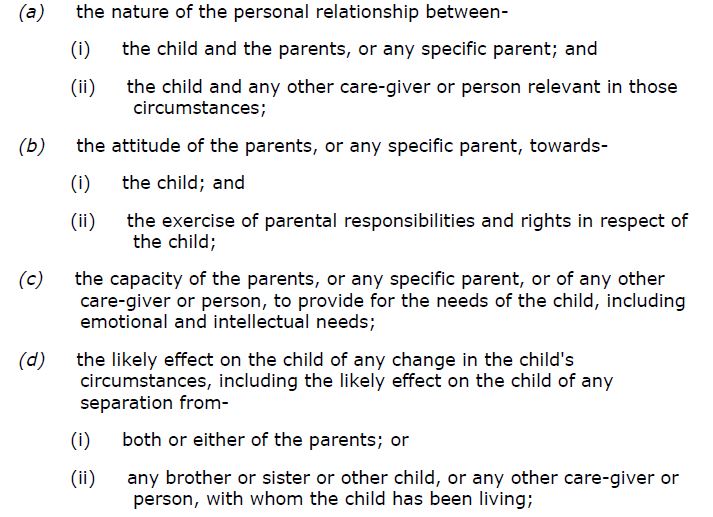
That is because the only thing the Children's Court or the Family Advocate is interested in finding out is what is in the child's best interests. If you want an idea of how they know what to look at these extracts from Section 7 of the Children's Act ought to give you an idea...


That is the reason why I do not fight about children to begin with.

If no agreement can be reached between the parents about contact with the children, where the children are to live or any other aspect of their care the Family Advocate has to be requested at the earliest possible time to investigate the matter so that I can have a recommendation as soon as possible. It does take months, but gives much better results than barking at the other party's attorney for months on end.

While the Family Advocate is attending to the children's situation we can then focus on the assets, liabilities and maintenance.

In our law parenthood is also virtually a lifelong commitment. Even when a parent is divorced he/ she has full rights and responsibilities of a parent, whether the child lives with him/ her or not. This is important for the primary caregiver- that is the parent with whom the child is staying- to remember, because just disappearing with a child so that the other parent does not know where the child is is actually a criminal offence. That means you can end up getting arrested and prosecuted.

A divorce court (During divorce Proceedings), a Children's Court and the High Court are the only institutions that can terminate any person's parenthood. A simple desire to stop being a parent or to stop someone else from being one is not enough, though.

A lot of people have already learnt that it is much better to rather have an agreement regarding the child's care and contact with parents than engaging in a costly battle from which neither parent has anything to gain.

I, for one, hope to see the end of such disputes soon, because this is definitely not the right country in which to have such disputes.


Monday, 29 August 2016

Beware the Money Bully

Hello, everyone who has managed to stumble upon this article and welcome to my Facebook page and this blog.

In this blog I will post news and articles from time to time and do my best to make the information here understandable to the people I serve, who are of course- the general public.


A lot of you may already know what the term "Money Bully" refers to. Some of you might have met one or about twenty and just did not know what they are.

I shall quickly explain what a money bully is and where you find such a person.

Money bullies are people who are in the position of client or employer and who uses the fact that they pay for goods or services rendered to get an unreasonable hold on employees, service providers or vendors.

The harm they do starts sneaking up on you when you swallow your pride and do your utmost to appease what appears to be a dissatisfied client and later hits you full in the face when you realise that your time, effort and money all got swallowed up in this huge black hole of abuse and grief.


Of what concern is this to a lawyer you may ask?
All our business transaction we find in our day to day lives are in fact contracts. Contracts give the parties thereto rights and obligations. It is of the utmost importance for all parties to know what their rights and obligations are before they can even think of approaching the Court to enforce or to rectify their agreements. Now this is where the Money Bully strikes the hardest. He/ she often does not want you to know what the full extent of your obligations are simply because he/she is determined to get as much out of you without paying.

A client I have once assisted ended up running a loss with interior decorating he had done for a client who seemed to keep changing her mind at a whim.

When I requested the client in a letter to give us her exact instructions in writing she had suddenly become quiet and left my client alone.

Other tactics employed by less aggressive money bullies (I can't really call these people bullies, because they don't really instill fear in anyone, but the tactics they employ are based on the same principles as those used by the more aggressive types) include a constant change in invoicing details, repeated requests for breakdowns of amounts and trying to change the topic with new or more instructions.

Your best defense against a money bully is ensuring that you know the terms of your agreement and that you adhere thereto. All changes to any agreement preferably have to be in writing and understood and signed by all parties.

Also- if you have eventually decided to sue for payment- requests for statements and offers to pay in instalments or to pay at al later date to not stay the time period of the summons. There is only one document that does that and it does so for a limited amount of time.

That's it from me. Stay well until next time!