Showing posts with label divorce. Show all posts

Friday, 9 August 2024

Divorce: Let's get realistic


So... your marriage is at its end and you want to get what is yours... Right...?

This entire idea of getting what is due is what keeps us attorneys working. If you have never been in Court before, however, you soon learn that having a right and enforcing a right are two different things altogether.

For one- having our constitutional rights cost nothing. Having those rights enforced, however, cost money- especially if it is a right to receive an exact percentage of property...

A defended / contested divorce can easily cost over R 100 000 just by letting the client pursue everything that he/ she wants out of the dispute. In most cases, however, what the client actually gets from fighting to the very end is far less than what it has costed.

Television and movies have romanticised the idea of acrimonious divorces where one party financially ruins the other. These movies and television shows should, however, give a warning for viewers to not try the same thing at home as trying to imitate the heroines in these stories has left many people with huge unpaid legal bills and no gratification.

So- if you are not going to walk out of your divorce rich- what can you expect?

Well- here are the realities that all divorces have in common:

1. You are now on your own- ...at least until you marry again or get yourself into a new relationship...

2. The other spouse has his/ her own life to deal with now. If you have children between you- be civil about it, because as divorcees each of you will have his/ her own problems to deal with and you can no longer count on that person for assistance or support in any other matter than that of caring for your children.

3. Your spouse does not want to give you any money. Not just money- but also any part of the assets that you have between you, be it accrued assets in a marriage out of community with accrual or assets in a joint estate. Don't be surprised if you find him selling off assets left and right after he has received the summons. If you want maintenance- be prepared to go all the way to hearing. Simply asking him to pay extra or writing a letter to his Attorney will not help...

4. Court processes take long. I mean, really, they can take years to finalise. If you do not have the stamina for years of fighting- settle for what is on the table.

5. Life is not as it was when you were married. You used to live in a house that was afforded with your joint income? Now you live in a small apartment and actually have to pay rent out of your income. The water and electricity bill used to be his problem? Now it is yours...

6. The Court no longer cares whose fault it was- Marriage is a choice. Terminating a marriage is also a choice. Nobody is perfect. These three truths are now foremost in the minds of our Judges and Magistrates who hear divorce matters. If you think you are going to score a forfeiture order for showing that your spouse was the first to cheat be prepared- the Court will still order a 50/50 division.

These things are true for all divorces. Along with them other things may or may not occur in various divorces.

So- what is the best thing you can do when you are getting divorced?

Well- there are a couple of things:

1. Get your finances in order: That maintenance payment is not reliable and enforcing it when it gets skipped takes time. Have a backup plan for when that money does not arrive;

2. Mediate- Yes. The Mediator costs money. So does the Court. You just think that it will be easier for you because you were able to emotionally manipulate your Attorney into accepting installments on your legal bills, but in truth an actual divorce trial in court takes much longer than  mediation and is far more expensive.

3. Apply for contribution- Your spouse has more money than you and now rather wants to litigate you out of pocket? Well... if that is the case you can apply to the court for an order that your spouse pays a contribution towards your legal costs.

4. Don't fight over the children- Seriously, you just look ridiculous doing that. If you and your spouse cannot agree on how the two of you will care and maintain contact with your children a Family Advocate will give guidelines.

5. Budget for maintenance expenses beforehand. Thinking about maintenance before the claim reaches you or before you institute the claim save you a lot of trouble afterward...

6. Settle- In the end- the freedom to move on and put the unpleasantness behind you will always be the best thing to get out of any divorce. When you get it is up to you. Nothing else is guaranteed. 


Lastly- in the years to come your divorce will be less than an afterthought. Life has a lot to offer each of us. Some of us wish to put it all on hold until we have finished fighting this or that battle. The more time you spend on fighting the longer you are putting life on hold. 

If you want to begin and end your divorce the right way- come and see us.

Friday, 24 May 2019

What you will need to know when you are getting divorced.

When I sit and think about what to write for these blog posts I try as far as possible to write about a topic which I have not seen anyone else write about in their newsletters or magazine articles and the like.

I have however been asked to write about divorce matters earlier this week. I have thought that the internet is already flooded with information and advice on this particular field of work which is done by most of the legal practitioners in my area. So- I reckoned- what difference shall it make if I am to write a blog post about this?

Well- I have been told by this interested member of the public- a lot of the information out there is written by lawyers for lawyers and is not easy enough to understand.

So-  what if I wrote an article that enabled you to get your own divorce matter started and that pointed out to you what you are to be prepared for?

That is exactly what I intend to do with today's post!


1. When and why you should get divorced

Morality and religion aside- it may not always seem like it, but our law does not allow for people to get divorced just because they feel like it. This may be a shock to some, but even two people who have agreed to get divorced can get sent back home by the Court to go and sort out their marital problems before they get divorced. Why would this happen?

It is because the Court can only divorce a married couple for one or more of the following reasons:

as taken from the Divorce Act 70 of 1979 as amended.


The reasons in part (b) needs very little elaboration, but it is usually the reason in part (a) above that gets presented to Court and get motivated in a wide variety of ways.

What are problems to work through for some are for others reasons why a marriage can no longer be.

I am not going to try to limit the definition of "irretrievable breakdown", but will point out that the clearest indications that require the least elaboration on- if any- are the following:

1. Living apart for more than a year;

2. One of the parties having committed adultery while the other party does not want to be in an open marriage at all.

3. One of the parties having been declared a habitual criminal by the Court and not getting out of prison anytime soon.

There are other indications as well. Whatever you may think are signs that your marriage has broken down beyond all hope of repair shall accepted by the Court as a reason to get divorced as long as the Court does not believe that it is a problem that can be solved by counselling, talking things over or just taking some time to think it over.


2. How to get started

Divorce courts are accessible to the public without the need for a legal representative. If you want to get divorced without an attorney you can start proceedings 100% on your own. If you do so the only person that you will need to pay shall be the Sheriff. This is why...

Your Regional Court has a Registrar that can be approached during business hours. If they hear that you want to get divorced they will give you a form to fill out. Thus form is actually your summons. Personally- I don't like those summonses because I know I can draft much better summonses myself, but they are still good enough to get your divorce matter going.

The minimum amount of information that you need to fill in is the following:

1. The names and addresses of yourself and your spouse;

2. If you have children- their names. You shall in this case need to attach copies of their birth certificates;

3. Where and when you got married. Your marriage certificate needs to be on hand in court and a copy thereof needs to be attached to the summons.

4. Whether you are married in- or out of community of property. If you are married out of community of property you shall need to attach a copy of your antenuptual contract. If you don't have one you can obtain a copy from the Deeds Registry where the contract got registered. It does not cost that much.

5. Why you deem the marriage have irretrievably broken down.

6. Where the minor children shall live and how the parent who does not have the children living with him or her shall maintain contact with them.


If the above is all that you wish to fill in you can get divorced without an attorney.

If you do wish to claim maintenance either for yourself or your children from the other party- you will really want to appoint an attorney to help you. In most cases the other party can accept the fact that he is getting divorced and go along with it. The moment they hear that their money is being threatened, however, they rush to find the nearest attorney. Well- not all of the defendants do that. Some will go for the most expensive attorney or the one with the best reputation...

If the Defendant (that is the other party- the one that you are suing for divorce) does not do any of the above he/ she most likely does not have much money to worry about in the first place and you may wish to reconsider your own claims- at least with regard to the amounts that you are claiming...

With the summons having been filled out/ drawn up the Registrar then has to issue it with a case number. It may take couple of days. It it is not done within a week, though, you shall have to get help because summonses that are not issued within a week have a high likelihood of having gone missing (here in Mbombela).

If you do receive your summons with its case number you then have to hand it to the Sheriff in the area where the defendant lives. The Sheriff delivers the summons to the Defendant in person and then gives you a report stating when a copy of the summons was delivered to the Defendant. 
 
The Court Rules provide for someone who receives a summons to give notice within two weeks that he/ she opposes any aspect of the divorce (like the amount of maintenance being claimed).

This is why you can only ask for your court date after two weeks from when the summons got served on the Defendant.

If the Defendant does enter appearance to defend you should rather get an attorney, because it is even possible for him/ her to get a court date without you knowing if he/she knows the court rules or is assisted by somebody who does. A Defendant who does this can even then go finalise the divorce without you knowing.


And this is how a divorce matter gets started.


Finishing one is another story altogether...


All that I will say is that you can easily get divorced in a month or two if you don't want any money from the Defendant. If you do claim money, though, you can expect the matter to drag on for years unless you have an attorney who know how to manage an opposed divorce.


I hope that this post is useful to someone out there and that he/ she shall be able to find his/ her way to getting the divorce action started. If any help is needed in finalising the matter you know who to call...


Monday, 5 September 2016

Access to children during divorce proceedings

Okay- it has been a decade since the Children's Act has been adopted here in South Africa and still we have parents who want to fight for "custody" over their children.

I guess this is what we get for taking legal advice from American television or that "Oom" or "Tannie" at the family gatherings.

The fact is- we do not have a thing such as "custody" over children in our law.


Does that surprise you?

Well- here is another one for you. No one, except for the child, has anything to gain or lose from Family Advocate investigations or Children's Court Proceedings.

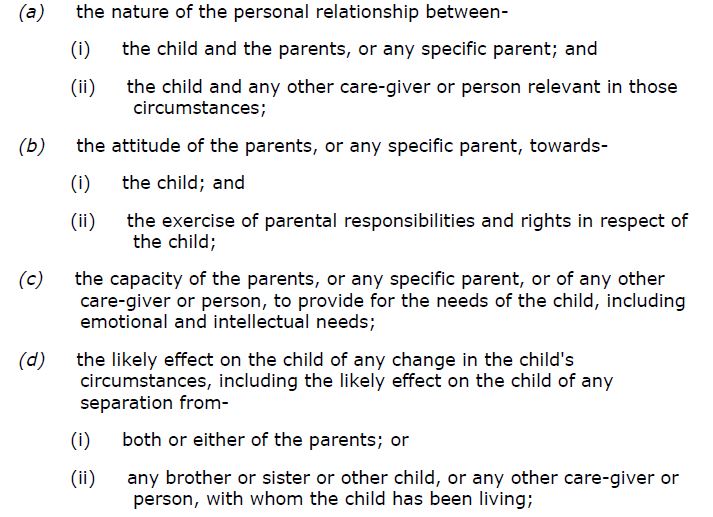
That is because the only thing the Children's Court or the Family Advocate is interested in finding out is what is in the child's best interests. If you want an idea of how they know what to look at these extracts from Section 7 of the Children's Act ought to give you an idea...


That is the reason why I do not fight about children to begin with.

If no agreement can be reached between the parents about contact with the children, where the children are to live or any other aspect of their care the Family Advocate has to be requested at the earliest possible time to investigate the matter so that I can have a recommendation as soon as possible. It does take months, but gives much better results than barking at the other party's attorney for months on end.

While the Family Advocate is attending to the children's situation we can then focus on the assets, liabilities and maintenance.

In our law parenthood is also virtually a lifelong commitment. Even when a parent is divorced he/ she has full rights and responsibilities of a parent, whether the child lives with him/ her or not. This is important for the primary caregiver- that is the parent with whom the child is staying- to remember, because just disappearing with a child so that the other parent does not know where the child is is actually a criminal offence. That means you can end up getting arrested and prosecuted.

A divorce court (During divorce Proceedings), a Children's Court and the High Court are the only institutions that can terminate any person's parenthood. A simple desire to stop being a parent or to stop someone else from being one is not enough, though.

A lot of people have already learnt that it is much better to rather have an agreement regarding the child's care and contact with parents than engaging in a costly battle from which neither parent has anything to gain.

I, for one, hope to see the end of such disputes soon, because this is definitely not the right country in which to have such disputes.